
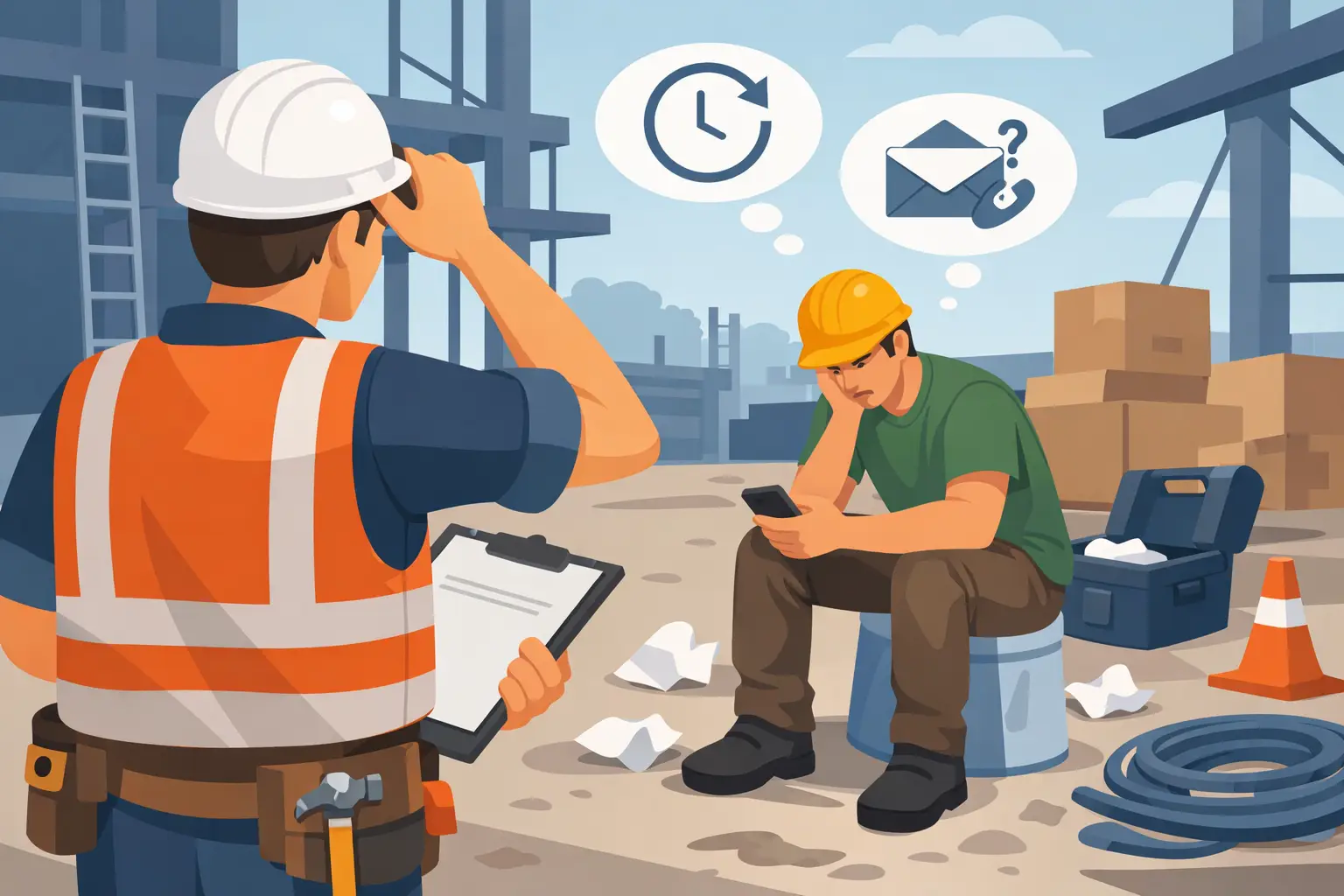
A lead asks for pricing on Tuesday. Your team sends the estimate that afternoon. By Friday, nobody has heard back, so the rep leaves a voicemail. A week later, they "check in" by email. Then the...
A lead asks for pricing on Tuesday. Your team sends the estimate that afternoon. By Friday, nobody has heard back, so the rep leaves a voicemail. A week later, they "check in" by email. Then the opportunity goes cold and everyone decides the prospect must not have been serious.
That is usually the wrong diagnosis. If you want to understand why sales follow up fails, start by looking at the system, not the prospect. In most trades businesses, follow-up problems are not caused by lazy salespeople or bad leads alone. They come from unclear process, weak communication, poor timing, and no real ownership of the next step.
Why sales follow up fails in growing trades businesses
The failure usually starts long before the second call or third email. It starts when a company grows past founder-led selling but keeps operating like follow-up is a personal habit instead of a managed business process.
When the owner handled every quote, they knew each customer, each job, and each open opportunity. Once more reps, CSRs, estimators, or project managers get involved, that same informal approach breaks down fast. People assume someone else is following up. Notes are incomplete. The CRM becomes a storage bin instead of a working tool. Good opportunities sit too long, and weak ones get too much attention.
That is why so many teams feel busy but still lose deals they should have won. Activity exists. Structure does not.
The real reasons follow-up breaks down
A lot of sales teams think the problem is frequency. They assume they just need more touches. Sometimes that is true, but more often the issue is that each touch is low value, poorly timed, or disconnected from the buyer's actual decision process.
There is no defined follow-up process
If every rep follows up their own way, performance will swing all over the place. One person calls twice and stops. Another sends six emails in ten days. Another waits until the end of the month when they need to fill the board.
A repeatable follow-up process should answer basic questions. What happens after the estimate is sent? How soon is the first follow-up? What channel gets used first? What is the goal of each touch? When does a lead move from active to stalled? If those questions do not have clear answers, inconsistency is guaranteed.
This is especially common in trades businesses where strong operators get promoted into sales leadership without being given the tools to build a sales system. They know how to run jobs. They may not have built a follow-up engine.
The team is following up without a reason
Most follow-up fails because it sounds like follow-up. "Just checking in" is not a strategy. Neither is "wanted to see if you had any questions."
Prospects respond when there is a reason to respond. That could be clarity on scope, a recommendation based on the site visit, a timing consideration, a financing option, an installation window, or a simple decision question that moves the conversation forward.
If your reps are only circling back because the calendar says to, buyers feel it. The message becomes forgettable, and the rep starts sounding passive instead of useful.
The first conversation was weak
A lot of failed follow-up is really failed sales discovery. If the initial conversation did not uncover urgency, decision criteria, budget range, competing options, or who is involved in the decision, then the rep is following up blind.
That leads to generic outreach because the salesperson does not know what matters most to the buyer. They send reminders instead of relevance.
Good follow-up starts by earning the right to follow up. If your first meeting ends without a clear next step, a real timeline, and a known reason the customer would move, the deal is already drifting.
There is no next-step discipline
One of the biggest mistakes in field sales is ending an appointment or estimate delivery without locking in what happens next. The rep says, "Let me know what you think," and then hopes persistence will make up for poor control of the process.
It rarely does.
Strong sales teams do not leave next steps open-ended unless there is a deliberate reason. They schedule the follow-up call. They define the decision date. They confirm who will review the proposal. They ask what could delay approval. That does not make the conversation pushy. It makes it professional.
Follow-up is not measured
What gets inspected gets improved. What gets assumed gets missed.
If leadership cannot see quote-to-close timelines, response times, open proposal aging, contact attempts, and stalled opportunity counts, then follow-up problems stay hidden until revenue misses show up. By then, the issue has been expensive for weeks or months.
A lot of trades companies track top-line sales and maybe close rate, but they do not track the middle of the pipeline well. That is where follow-up either creates momentum or kills it.
Why sales follow up fails even when reps are trying hard
Effort can hide bad process for a while. A hardworking rep may keep deals alive through sheer persistence. But if the system depends on personal memory, heroic effort, or whoever happens to be most organized, it will not scale.
That matters more as your business grows. More leads, more estimators, more service lines, and more handoffs create more chances for opportunities to stall. Without a standard, the team starts inventing its own version of sales management.
There is also a morale cost. Reps get frustrated when they feel like prospects are ghosting them, but often the company trained them to follow up in a way that gives buyers no compelling reason to engage. Then leadership tells them to "be more consistent" without fixing the process itself.
Consistency is not a personality trait. It is an operational outcome.
What better follow-up actually looks like
Fixing follow-up starts with accepting that this is not just a communication issue. It is a sales process issue.
First, define the path after every proposal, estimate, or sales call. The team should know exactly what happens in the first 24 hours, the first 3 days, the first week, and beyond. That does not mean robotic scripts. It means clear standards.
Second, improve the quality of the initial conversation. If your reps are not uncovering buying motives, risks, timeline, decision-makers, and likely objections, follow-up will stay generic. Better discovery creates better follow-up because the rep has something real to reference.
Third, require a specific next step before the conversation ends whenever possible. A scheduled review call beats an open-ended promise to reconnect. A defined decision checkpoint beats waiting around.
Fourth, make follow-up value-based. Each touch should do one of three things: add clarity, reduce risk, or move the buyer toward a decision. If it does none of those, it is probably noise.
Finally, create accountability around pipeline movement. Managers should be reviewing aging proposals, listening to how reps tee up next steps, and coaching message quality, not just touch count. A rep can make eight weak follow-up attempts and still avoid the real issue.
The trade-off most owners miss
There is a balance here. Too little follow-up loses winnable business. Too much bad follow-up damages trust and makes your company feel desperate.
That is why there is no magic number of calls or emails that works for every lead. A homeowner comparing three bids needs a different cadence than a commercial buyer with a formal review process. A replacement decision with urgency moves differently than a nice-to-have upgrade.
The answer is not pressure. The answer is control, relevance, and timing.
For trades businesses, that often means building a follow-up system that supports natural selling instead of forcing canned scripts. Buyers can hear the difference. They respond better when the salesperson sounds like someone managing a real project, not someone chasing a commission.
Follow-up failure is usually a leadership problem
That may sound blunt, but it is usually true. When follow-up is inconsistent across the team, leadership has not made the expectations, tools, and coaching clear enough. Reps own execution, but leaders own the system.
If your team loses deals after proposals go out, do not start by telling them to "try harder." Look at the handoff points, the message quality, the inspection rhythm, and the metrics. Look at whether your process helps a rep lead the sale or just react to silence.
This is where experienced sales coaching matters. Companies like Leading Sales Results work with trades businesses to fix exactly these breakdowns because the issue is rarely solved by motivation alone. It gets solved when follow-up becomes part of a structured sales engine with standards, coaching, and accountability.
When your team knows what to say, when to say it, and what outcome each touch is meant to produce, follow-up stops feeling like chasing. It starts doing what it should have been doing all along - helping good buyers make clear decisions.